
This article shared seven things I had learned over the course of seven seasons of the show.
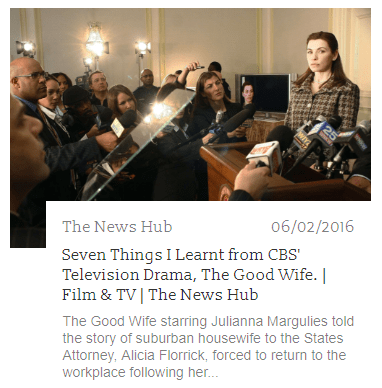
Seven Things I Learnt from CBS’ Television Drama, The Good Wife.
The Good Wife starring Julianna Margulies told the story of suburban housewife to the States Attorney, Alicia Florrick, forced to return to the workplace following her husband’s, Peter Florrick, imprisonment for embezzlement and for using state funds to hire prostitutes, in order to provide for her family. Since 2009 this legal drama has brought heart-pounding entertainment, “oh my god” moments, and so much more to the screens of millions around the world.
When I first found out the seventh season would be the last, I was sad and in denial. For the last seven years I had watched it religiously and had taken comfort in the trials and tribulations of all the characters, learning about people and how to tell an enticing story. I had watched the first couple of seasons about three times, and had found the premise and abundance of themes of the show allowed for several references and topics for school essays – I’d say The Good Wife was the main source for my two of my dissertations. Not wanting my experience to end, I postponed watching season seven until all the episodes had aired so that I could have a binge marathon to say a good farewell. So to commemorate the ending of TGW, I’m listing seven things I learnt from one of my all-time favourite shows.
- You can always bounce back from anything if you’re determined enough (and even if you’re not)
- From season to season, no matter how absurd or unlikely, if there was one thing you could be absolutely sure of it was: THE BOUNCE BACK. Everyone, Alicia in particular (I mean it is her show after all), always seemed to find themselves on their feet following a devastating defeat; and as frustrating and illogical as it was from time to time, it really got me thinking. Nothing is ever as bad as you think it is and it’s not over until it’s over – and sometimes even then it’s still not over. Watching Alicia claw her way back to stability following her husband’s initial imprisonment was so inspiring (though I wasn’t aware at the time), and showed me that if you have the desire, determination (and good a connection or two) you can come back from the dead and start over. I also learnt that regardless of whether or not you are prepared to bounce back, life moves on so quickly that in the end you’ll find yourself moving on and bouncing back even if you don’t want to. So when the very last episode ended with many questions unanswered and something of a cliffhanger, while I was disappointed we wouldn’t know exactly what happened next, I knew that Alicia would figure it out and bounce back stronger than ever.
- You can grow the most through hardship
- And to follow on from the above point, real growth comes from going through hardships and learning more about yourself and how to deal with similar situations in the future. This is something we as the audience saw with Alicia throughout the series. With every let-down, heartbreak, defeat and disappointment, Alicia grew to be more resilient, defiant and badass. From this I’ve seen how hardship shouldn’t knock you down and leave you feeling weak (I mean it can for a moment, but not for ever); instead it should encourage you to learn from what happened and to use it to make you stronger and better equipped for next time.
- Alan Cumming really is amazing
- It’s not like I didn’t already know this after Annie and Spy Kids, but when you haven’t seen one of your favourite actors in a while, it’s nice to be reminded. When Alan Cumming became a regular in season two I was ecstatic! Like I just mentioned, I had loved him in some of my favourite childhood movies and hadn’t been keeping up to date with his work (unless you count him as Kurt in X-Men 2). Cumming’s turn as political advisor/genius/resident troublemaker, Eli Gold, was well, gold. While he was cunning, calculated, tough as nails and ambitiously goal oriented, Eli was also the heart of the drama, kind, compassionate and extremely loving of the Florrick family and those who he trusted to open his heart to. I found myself loving him even more with every curt remark and eyebrow raise, and I’ll definitely miss the interactions with his onscreen daughter Marissa (played by Sarah Steele), who seemed to be the only person able to wrangle i.e. handle Eli’s madness.
- Friendships are special
- If, like Alicia, your home and work life can be chaotic, stressful and hard to handle having a core group of friends is not only crucial to keeping your sanity, but a nice respite from the madness. Despite a few shaking story arcs that saw their relationship tested (and temporarily end) I’d say Kalinda and Alicia’s friendship was extremely special. They had a similar sense of humour and a genuine understanding of the other. I also think that because Kalinda was Alicia’s first real friend following her husband’s scandal, it made their relationship all the more meaningful as it showed how two extremely guarded people can let their guards down and become friends. Then, following the departure of Kalinda at the end of season six, and the introduction of Lucca Quinn at the beginning of season seven, we saw Alicia navigate a new friendship, expressing herself to someone in a way we hadn’t seen all seven seasons. (I’m talking about the episode where Alicia cries to Lucca about Will.) I really learnt that it only takes one person to make you feel comfortable enough to be vulnerable, to get who you are as a person, to allow you to bring your inner walls down, and that if you find that someone, you are THE luckiest person in the world because it is hard finding those special and meaningful friendships.
- Betrayal is real
- It’s not every day that you’ll be subject to the biggest betrayals of your life, like: your husband cheating on you with prostitutes, or your employees staging a hostile takeover and threatening to take all your clients, or finding out that someone you considered a friend slept with your husband, or finding out that the love of your life left you a message ten years ago that had you listened to it would have changed the course of your life (and the series); but when those times hit and people’s true colours are shown it can be hard to handle. Yes it’s pretty obvious that betrayal is real and it has the potential to hurt like hell, but as I’m yet to experience it on such a big scale, watching The Good Wife really brought it front and centre. Now, seeing as the series was basically built upon the betrayal of a husband to his wife, and the ramifications it had on her life, it’s fair to say that sometimes betrayal isn’t the worst thing that can happen, and that going back to the first thing I learnt watching this series, it can make you a stronger, smarter person.
- It’s never too late
- And what exactly is “it” you ask? Well IT is anything. Like I stated at the beginning, The Good Wife is about a woman who returns to the workforce following her husband’s indictment, so in this instance, it’s never too late to go back to work or to provide for your family like Alicia did. Will and Alicia were college sweethearts who weren’t quite able to make it work, but then fast forward almost fifteen years when Alicia’s looking for work and Will throws her a lifetime. As the first series continues, we see them rekindle their college love until they begin a full-blown affair; so in this instance, it’s never too late to reconnect with your true love. When Will and Alicia’s love is hanging in the balance, he leaves her a voicemail (that could have easily changed the game in both their lives) only Eli deletes the voicemail and Alicia never gets to hear it (and then so ends Will’s and Alicia’s love story – although there was obviously tension between the two characters as evidenced through their constant warring). Fast forward Wills death, a few other love interests’ and several life changes later, Eli finally admits to Alicia what he did and tries to make thing right and apologise to her; so in this instance, it’s never too late to apologise. Though things may seem scary, and the “right” time may have passed, in the grand scheme of life, it really never is too late. It’s never too late to right a wrong, confess your love or go back to a passion of yours; and this is big lesson to take from a show that was about self-discovery, reinvention and having the balls to do both.
- Chicago is worth a visit
- The main thing that really set The Good Wife apart from other shows was definitely it being set in Chicago. Normally with shows like this you would have expected it to set on either the East or West coast, so when it was shown to be set in Chicago, it made a nice difference. The setting of Chicago allowed for more themes such as race, politics and corruption to be dealt with more thoroughly as Chicago (and the state of Illinois as a strong history and ties to these particular issues). I also think that with other legal dramas such as Damages, Law and Order and Suits, being set in Chicago made the series all the more original and a breath of fresh air. All that being said, even though technically they did film in New York it still gave audiences a glimpse of Chicago life and made me want to visit city more than anything. It even inspired me to set one of my own stories in Chicago too.
The Good Wife will most definitely be missed by many, but on a positive note, last week an online spinoff was confirmed for next year, AND on top of that, TGW has been adapted for Korean television and will soon hit their screens in July – and you can be sure I’ll be watching that and sharing my thoughts.
 Alice Okoye's Portfolio